
Discord’s planned age verification system has hit pause. After facing criticism from users over privacy concerns and implementation details, the company has officially announced that it is delaying the global rollout of its age verification system until the second half of 2026.
The update was shared directly by Discord, where the company acknowledged community feedback and outlined several key changes it plans to make before expanding the system worldwide. While Discord stated it will continue to comply with legal obligations in regions where age verification is required, a full global rollout will now only happen after additional improvements are implemented.
As detailed in Discord’s announcement, the company plans to introduce more verification options, including alternatives such as credit card verification. It also committed to increasing transparency around third-party vendors involved in the verification process. Notably, Discord set a new requirement that any partner offering facial age estimation must process it entirely on-device, meaning no external data transfer. Vendors failing to meet this standard will not be used.
The company is also building a dedicated spoiler channel option. Discord explained that many communities use age-restricted channels not for adult content, but for topics such as spoilers, politics, or heavier discussions. This new feature aims to reduce the need for full server-wide age gating in those cases.
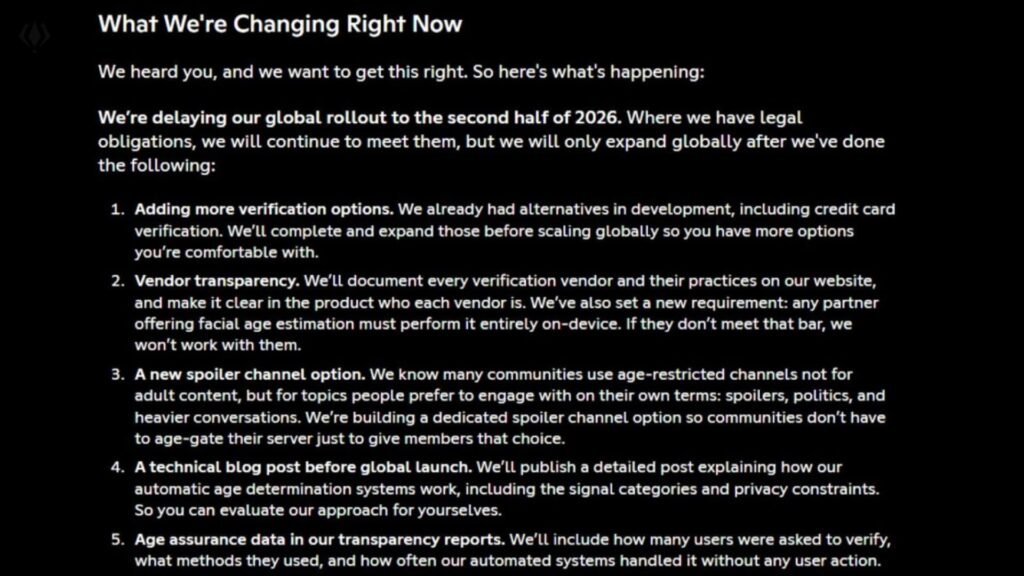
In addition, Discord plans to publish a detailed technical blog post explaining how its automatic age determination systems work, including signal categories and privacy constraints. The company also confirmed it will include age assurance data in its transparency reports, outlining how often users were asked to verify and which methods were used.
The delay signals that Discord is attempting to recalibrate its approach amid user concerns, particularly around data privacy and facial recognition technologies.
Whether these added transparency measures and alternative verification options will ease user concerns remains to be seen. Will this revised approach rebuild trust or will ongoing doubts about digital age verification continue to dominate the conversation? Share your thoughts in the comments below. Stay tuned to VGNW for more updates, and follow us on X to catch the latest developments.